The European STOP Digital Twin for Precision Optics
Structural-Thermal-Optical-Performance analysis, mastered in one closed loop.
STOPTIMA is an integrated software workflow to predict the optical performance of engineering systems under realistic structural and thermal operating conditions. STOPTIMA connects multiphysics simulation and optical analysis in a unified engineering workflow.
Optical performance does not exist in isolation
Your optical design is not floating in the air
Every lens, mirror, and detector lives on a structure. That structure expands, bends, and vibrates — and even sub-nanometre deformations can turn a diffraction-limited system into a performance-limited failure. So, an optical system operates in a physical environment where:
-
- Temperature changes.
-
- Structures deform.
-
- Components move.
-
- Optical surfaces change position and orientation.
These physical changes can affect the performance of the optical system.
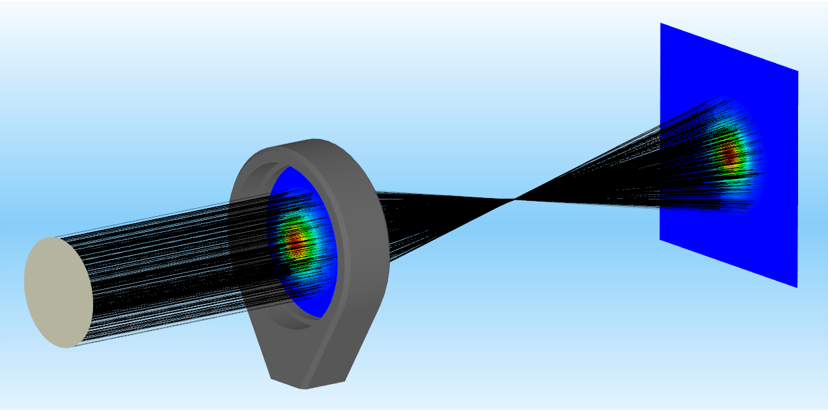
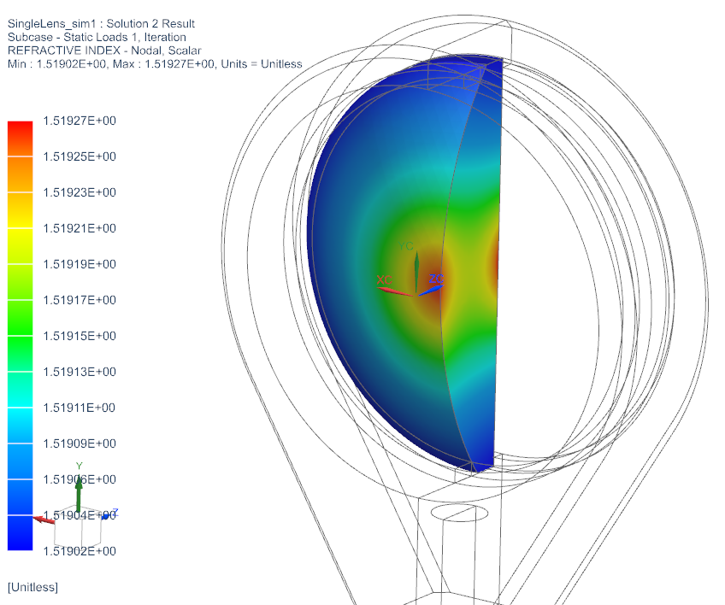
Refractive index distribution in space.
These engineering disciplines are often treated separately. Traditional workflows connect solvers through manual file exports — losing fidelity, breaking the feedback loop, and forcing engineers to pad margins instead of validating physics
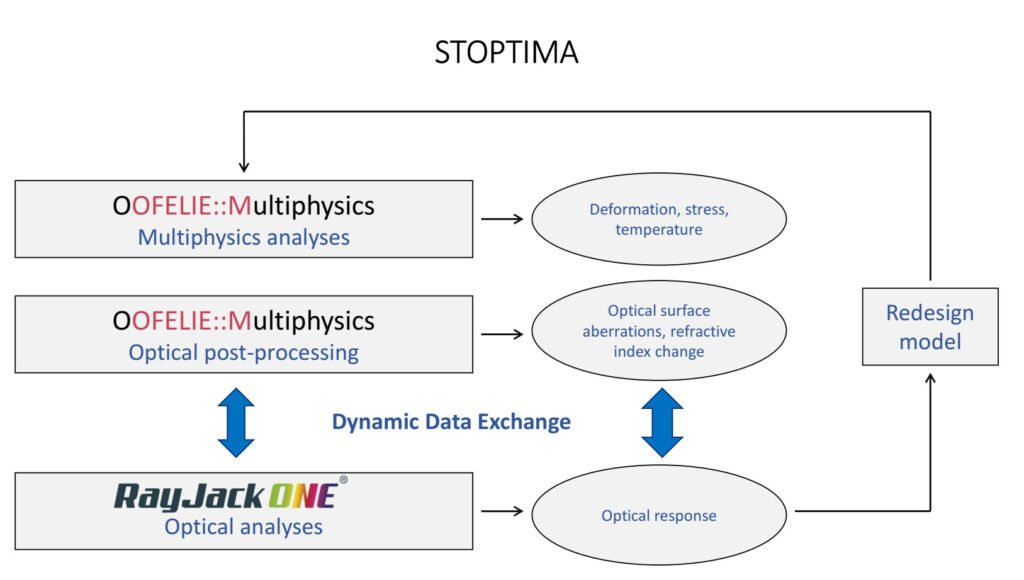
From physical conditions to optical consequences
STOPTIMA helps engineers investigate questions such as
-
- How does thermal loading affect optical performance?
-
- What is the impact of structural deformation?
-
- How sensitive is an optical system to mechanical displacement?
-
- How do operating conditions influence optical alignment?
-
- What optical performance can be expected in realistic environments?
What STOPTIMA models
Classical STOP workflows exchange deformations as polynomial fits or point grids. That works — until the surface stops behaving like a polynomial. STOPTIMA carries the full physics of the deformed surface into the optical model.
Surface deformation
Structural and thermal loads displace every optical surface. STOPTIMA transfers that deformation to the optical model in the representation your design demands:
- Zernike polynomial decomposition — the industry-standard basis for wavefront analysis.
Point-grid deformation — direct mapping of nodal displacements onto optical surfaces. - Legendre polynomial basis — an alternative decomposition suited to rectangular apertures.
- Free-form NURBS surfaces — full geometric fidelity for free-form optics, where polynomial fitting would smear away the very features the design depends on.
Beyond classical STOP
Some effects are invisible to a ray-trace that assumes uniform, isotropic media. STOPTIMA models them:
- Spatially varying refractive-index (GRIN) fields — temperature and stress gradients turn nominally homogeneous glass into a graded medium. STOPTIMA models the resulting index distribution across the optic, not just a scalar shift.
- Stress-induced birefringence — mechanical stress makes optical materials anisotropic. The resulting photo-elastic effect alters polarization state and introduces wavefront error. STOPTIMA propagates stress fields from the structural solution into polarization and wavefront predictions, so this degradation appears in the analysis rather than in the test campaign.
Ready to master your STOP analysis?
Whether you’re evaluating a first project or integrating STOPTIMA into your engineering workflow, talk directly to the team who built it.